



Choosing wine for a gift sounds easy. Then you stand in front of a shelf, or scroll through a website, and the whole thing goes sideways. Scores. Medals. Heavy bottles. Fancy labels. Words like "minerality," which to my mind often drift into the bullshit zone of wine terms.
I'm Michael Palij. I've worked in wine since 1989, became a Master of Wine in 1995, and I've spent much of my career swashbuckling and trying to find new producers, especially in Italy. I taste a huge number of wines for Opimian. Many are clean, polished, and utterly forgettable. Technically perfect and lacking personality.
That is no use for a gift.
When I buy a wine for somebody else, I want two things. I want generosity. I also want thought. If you can manage both, you're in very good shape.
Key Takeaways
- High-tannin red wines pair effectively with protein-rich foods like steak because the wine's tannins latch onto the food's proteins instead of drying out the drinker's salivary proteins.
- Gifting Italian grape varieties like Piedirosso or Nerello Mascalese provides Pinot Noir lovers with a similarly elegant, perfumed, and savory wine profile from a novel region.
- Second wines from top Bordeaux estates, such as Les Forts de Latour, receive the exact same vineyard and cellar care as the primary Grand Vin, offering prestigious pedigree at a lower price point.
- Timorasso from Italy's 1,250-hectare Colli Tortonesi DOC provides a complex, historically rich alternative for wine drinkers who typically prefer mainstream styles like white Burgundy or other fine Chardonnay.
- Italy offers highly differentiated gifting options due to its vast viticultural diversity, featuring nearly 600 officially registered grape varieties and 527 distinct wine denominations.
- Although a 2024 YouGov survey found that 63% of wine consumers never spend over $40 per bottle, research indicates that higher price cues artificially inflate a drinker's perception of a wine's quality.
First, Decide What Job the Bottle Is Doing
This is where most people go wrong. They start with the bottle. I start with the job.
Are you thanking a host? Taking wine to dinner? Buying for a client? Marking a birthday? Trying to impress somebody who knows wine? Those are different missions. The right answer changes with the occasion. Do as much homework as possible before you buy – that's the 'thought' part.
I'll say something unfashionable straight away. There is nothing wrong with spending money. If you are in a pickle and you need a bottle that clearly signals appreciation, a genuinely expensive bottle will usually do that. When I worked in China, I saw this all the time. Giving a costly bottle was a way of "giving face". The expense itself signalled both respect and gratitude.
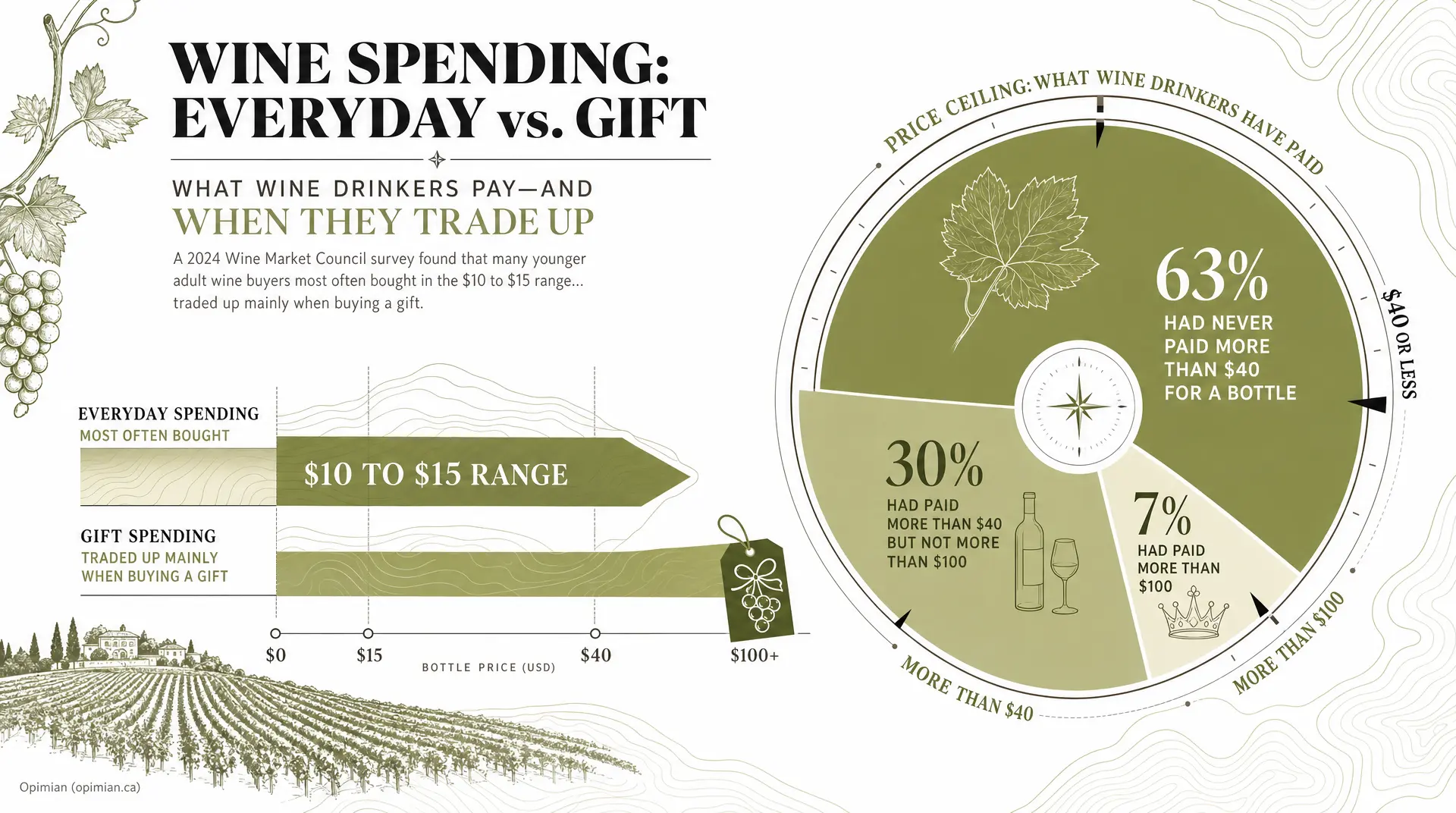
That instinct is more common than people think. A 2024 Wine Market Council survey found that many younger adult wine buyers most often bought in the $10 to $15 range for themselves, and traded up mainly when buying a gift. If you spend more on a gift than you do on your own Tuesday-night bottle, you are behaving perfectly normally.
At the same time, I would not let price do all the thinking for you. Another survey found that 63% of wine drinkers had never paid more than $40 for a bottle, while only 7% had gone past $100. That should relax you. Most people are not living in trophy-bottle territory.
And price is a funny thing anyway. In more than 6,000 blind tastings, the link between price and enjoyment for non-expert tasters was actually small and negative. On the other hand, researchers also found that higher price cues made identical wines seem more pleasant. So yes, price changes perception. But the wine still needs to suit the person.
That is the point. Money can help. Thought helps more.
Start with the Person, Not the Shelf
Most people buy the wine they would like to receive. That is lazy. Buy the wine the other person will enjoy.
Think about what they already drink. Do they love rich reds? Crisp whites? Champagne? Are they adventurous, or do they want something familiar? Are they opening it tonight, or are they the sort of person who likes to put bottles away? Do they care about labels and points, or do they enjoy discovering something new?
That is where the gift becomes personal.
Sometimes the easiest link is outside the glass. Maybe their family came from Italy or Spain. Maybe they are going on holiday to South Africa or Chile. Maybe it is a birthday and you can tie the bottle to a vintage. Maybe you know they are obsessed with one region or one grape. Use that. A good gift always gets stronger when it connects to the person receiving it.
There's useful research here too. A special-occasion buying study found that the strongest cues were having tasted the wine before, region of origin, and recommendations from friends or relatives. That makes perfect sense. If you've tasted the wine, wonderful. If you haven't, borrow expertise. A good merchant earns their keep right there.
Busy professionals should do exactly that. You do not need to become a full-time student of wine to buy a thoughtful bottle. You do need to ask the right questions.
Food Matters More Than People Think
If you are bringing wine to dinner, ask what is being served. Why wouldn't you? That one piece of information makes your life much easier.
If the food is smoked salmon, a good Riesling is often a brilliant gift. The alcohol is modest, the acidity is refreshing, and the whole thing feels lively. If the table is game casserole or blue cheese, a fuller, more powerful wine such as Amarone makes much more sense. The higher alcohol and richer structure have somewhere to go.
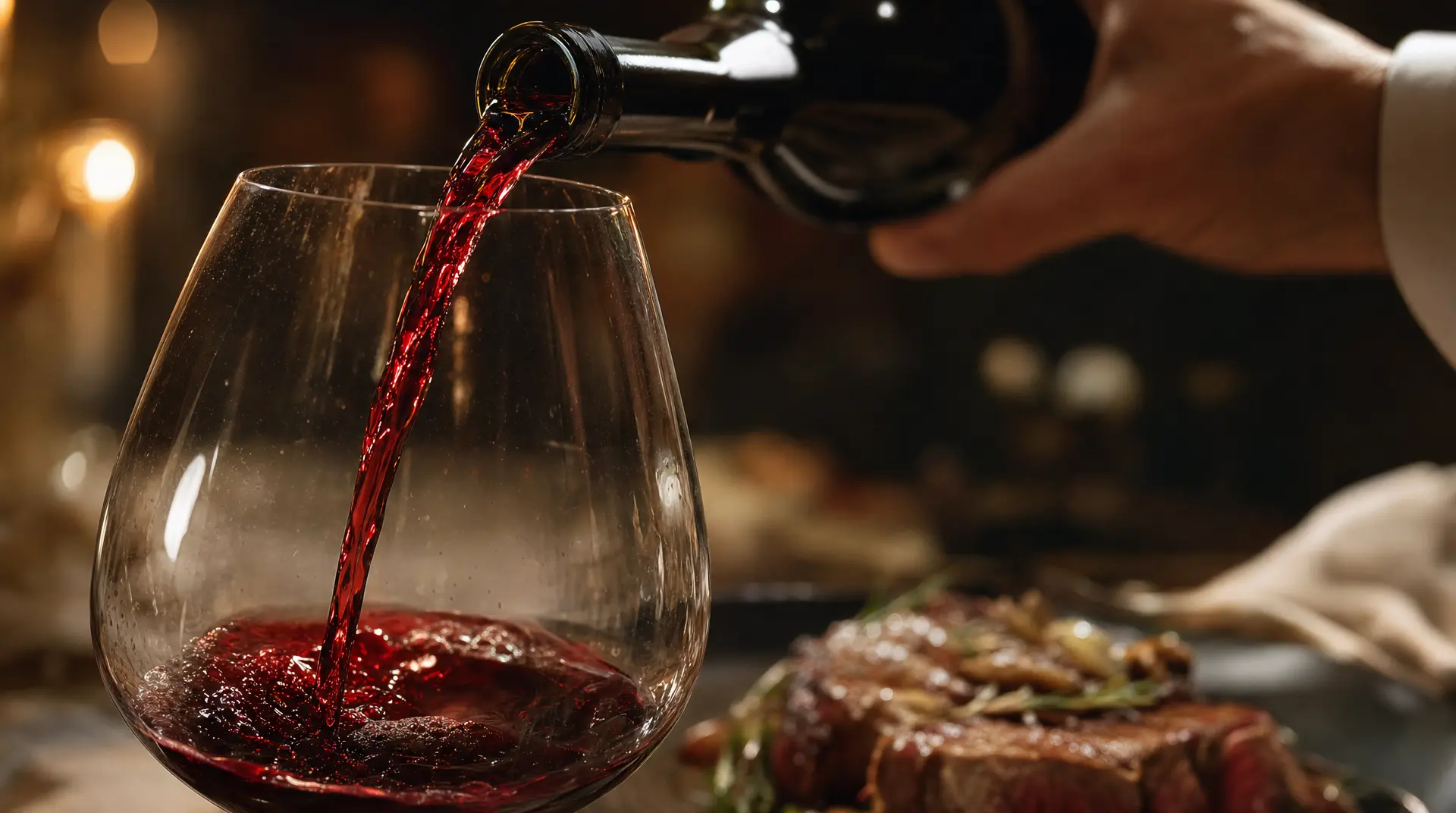
And if the meal is steak, pizza, or spaghetti bolognese, a more tannic red can suddenly look very clever indeed. The science is simple. Those protein hungry tannins latch onto the proteins in the food, which is why red wine and steak are such old friends. In a red wine, tannins would be that narrative arc. They take the wine from the beginning, through the middle, to the end.
One technical point is worth remembering when you are choosing a gift. Acidity matters. Acidity is the sort of brake pedal on a wine's development. It keeps a wine fresh. It stops a bigger wine from becoming tiring. It also helps stability. A 2023 review noted that higher wine pH increases microbial risk and instability. You don't need to memorize the chemistry. Just remember that balance matters far more than brute force.
And unless you know the recipient is a serious collector, be a little careful with very brooding wines. By brooding, I mean a wine with weight, intensity, and a future ahead of it. Those can be marvellous. They are not always ideal if somebody is pulling the cork that same evening with smoked salmon.
Use a Clever Swap, Not a Random Obscure Bottle

This is where gifting gets interesting.
I love obscure grapes. I love backwaters. I love producers nobody has heard of. But I would never hand somebody a random unknown bottle just to prove how clever I am.
The trick is to make a bridge from what they already love to something they have not still met.
If They Love Pinot Noir
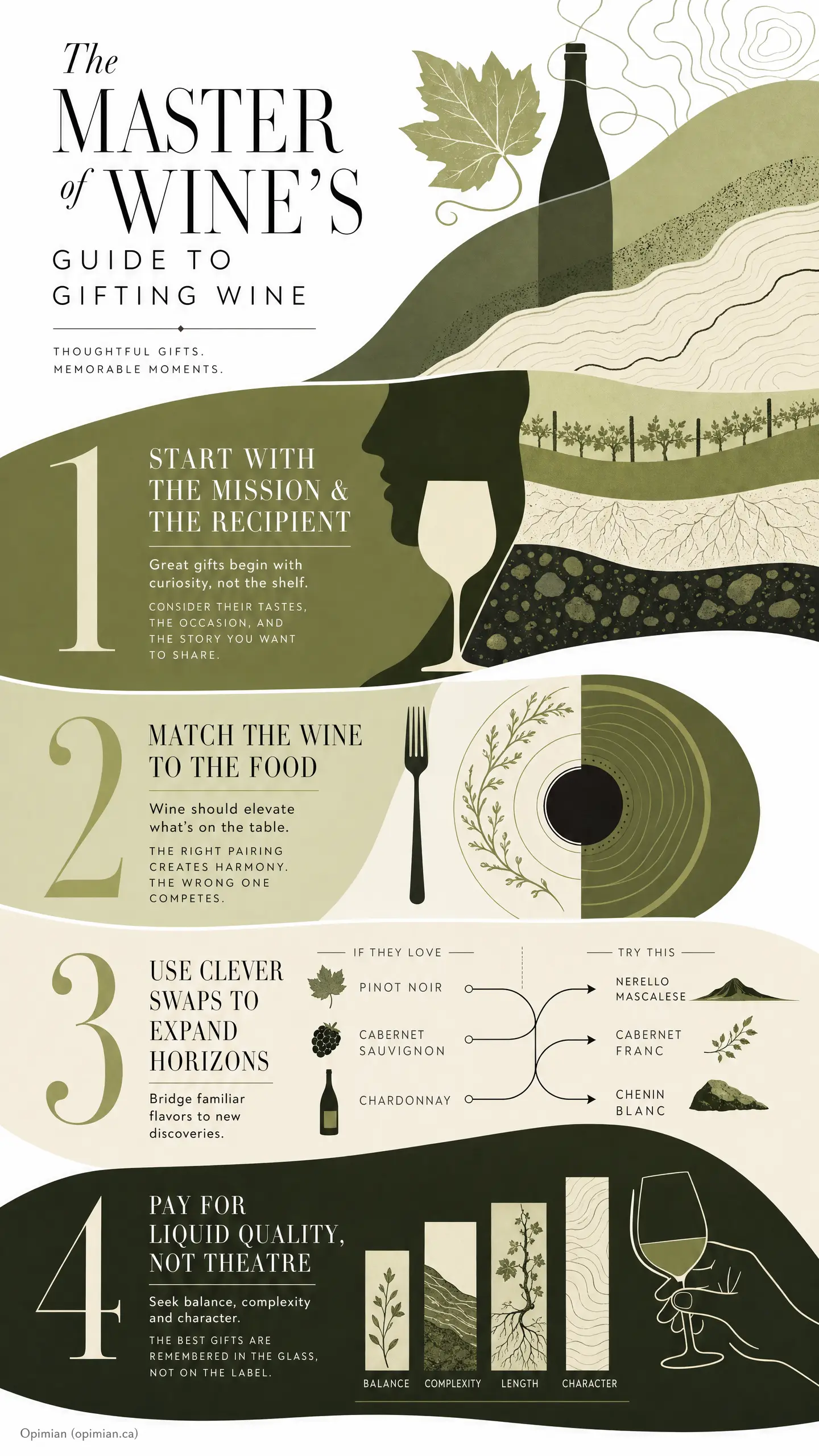
If I know the recipient loves Pinot Noir, I might look at Piedirosso from southern Italy or Nerello Mascalese from Etna. Both can bring perfume, lift, savoury detail, and elegance. They are not Pinot Noir. They do, however, scratch a similar itch.
And when you hand the bottle over, the line is easy. You can say, "I know you love Pinot Noir, so I found you an Italian red with that same sort of finesse, but from a completely different place." That is enough. You've made the link. You've done the thinking.
If They Love Bordeaux
This comes up all the time, especially in business gifting.
If somebody loves expensive Bordeaux, one smart route is to buy a Cabernet Sauvignon made by a Bordeaux château in another country. The link is obvious, but the price is often much kinder. Domaines Barons de Rothschild Lafite's Chilean estate, Los Vascos, is planted primarily to Cabernet Sauvignon and made in a Bordeaux style. That is a clever swap because the reference point is still there.
The other smart move is the second wine of a top estate. I've said this before and I mean it: in a great vintage, the gap between the grand vin and the second wine can be much smaller than the price gap. Château Latour says that the same vineyard and cellar care goes into Les Forts de Latour as into the Grand Vin. If you know your recipient values pedigree, that can be a very thoughtful way to buy.
And if they are swayed by scores, be pragmatic. You do not need to worship scores. The market certainly does. In Bordeaux futures, expert ratings had a significant impact on prices. So if your client or friend cares about a sticker on the bottle, factor that in.
If They Love Serious White Wine

This is where Italy can be magical.
About 25 years ago, I found Walter Massa, who was preserving Timorasso when it was nearly forgotten. He was on the verge of giving up, and for a period I became his sole export customer. That wine blew my mind. It was complex, characterful, and completely unlike the obvious mainstream choices.
That story still matters because it captures what makes a great gift. You are not just giving liquid. You are giving discovery. You are giving a bottle with a past.
Pay for Wine, Not Theatre
There is only so much money you can spend making the liquid itself. After that, you are often paying for brand prestige and land value. That may be worth it to you. Fine. Just be clear about what your money is doing.
Buying expensive wine is really, really easy. All you need is a wallet.
Buying great wine that nobody's heard of is much, much more difficult.
That is why I always come back to the same quality framework. I look at balance, length, intensity, and complexity. Complexity is not how big something is. It's how many different things there are. If a wine performs strongly on those points and the price is still sensible, now I'm interested.
At Opimian, that is exactly what we look for. Our Masters of Wine taste the wines ourselves. We ignore third-party critic scores when we select for the club. We pass on plenty of wines that are polished but generic. If one of the highest-scoring wines also comes in at an accessible price, boom, that is the sort of bottle that can earn a Coup de Coeur.
That matters in gifting. A memorable bottle should overdeliver. It should not just arrive in a heavy bottle with a marketing budget attached to it.
I would also be careful with heavily romanticized styles. A gift bottle should be clean. Mother nature doesn't make wine, mother nature makes vinegar. If what you are handing over smells of volatile acidity, which is just a fancy way of saying vinegar, you haven't chosen something soulful. You've chosen something faulty.
And if what you're tasting is winemaking process rather than the grape or the wine itself, then I start to ask some questions.
Why I so Often Look to Italy for Gifts
I fell in love with Italy in the early 1990s, and I've now visited the country more than 100 times. For gift hunting, it is one of the richest places on earth.
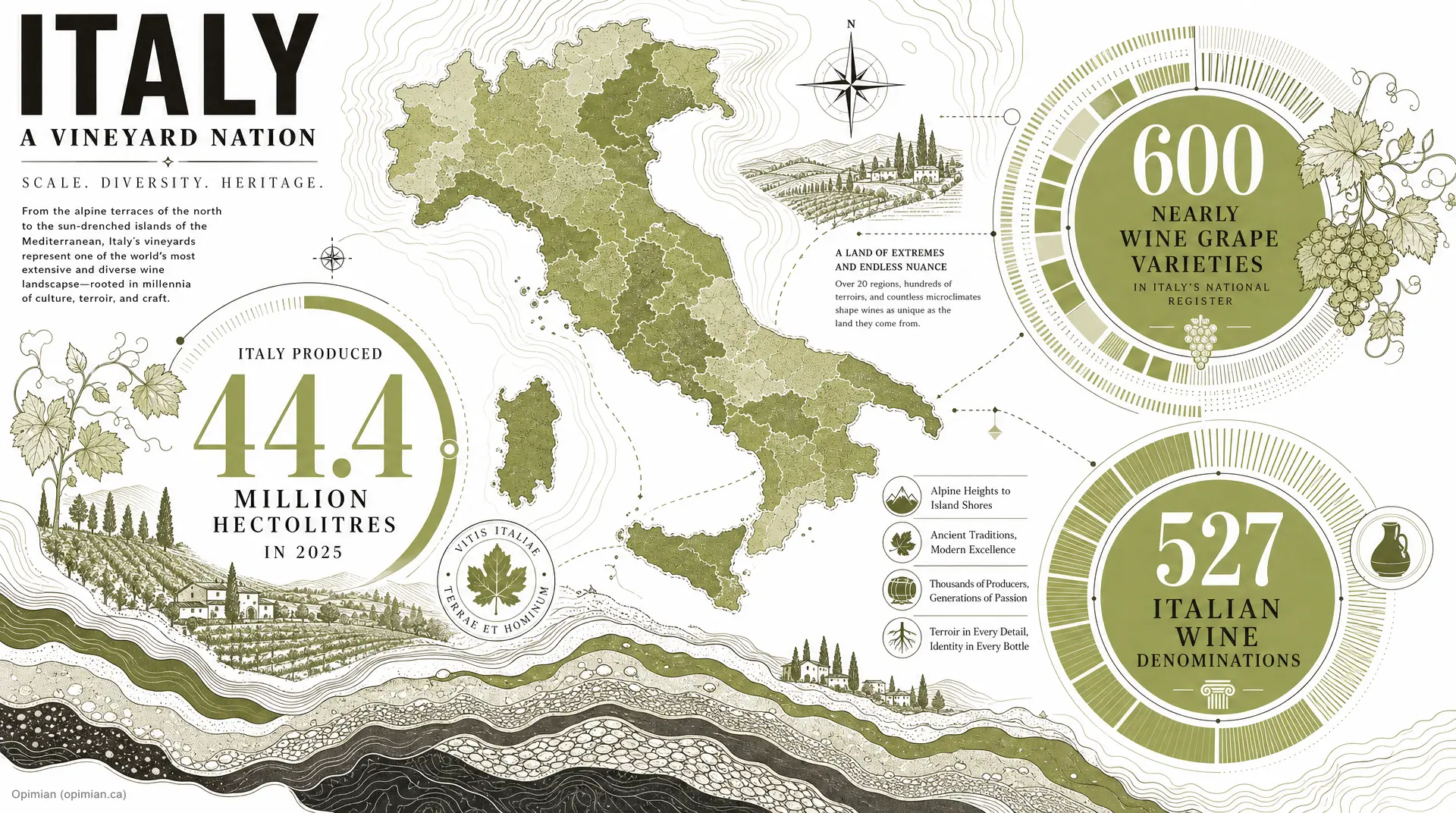
The scale is enormous. The OIV says Italy produced 44.4 million hectolitres in 2025. But volume is not the exciting part. Diversity is.
A peer-reviewed genetic study lists nearly 600 wine grape varieties in Italy's national register. The 2024 Atlante Qualivita records 527 Italian wine denominations. That is absurdly fertile ground for thoughtful gifting.
When I try to explain Italy simply, I come back to three attitudes. Inventiveness. Tradition. Family.
Italian producers are endlessly inventive. They will plant things in new places and try ideas the French would never permit. At the same time, Italy is soaked in tradition. Tiny appellations carry centuries of history. Many are commercially irrelevant. Culturally, they are gold. And then there is family. You feel it everywhere, from tiny estates to larger wineries.
That is why Italian wine makes such strong gifts. It carries story.
Consumers often meet Italy from the wrong ends of the market. They buy cheap, badly made Chianti, Soave, or Valpolicella and conclude that Italy is disappointing. Or they spend serious money on international grapes from Tuscany and miss the Italian bit entirely. The sweet spot is usually in the middle. Native grapes. Real places. Sensible prices. That is often where the best gift lives.
The Line You Say When You Hand It Over Matters
You do not need a speech. You need a hook.
When I write a tasting note, I'm always hunting for the thing that makes somebody stop and say, "I want to try that." The same rule applies to gifting. Give the recipient one simple reason you chose the bottle.
If it is a Piedirosso or Nerello Mascalese for a Pinot Noir lover, tell them that. If it is a Bordeaux-style Cabernet from Chile made by a famous Bordeaux house, tell them that. If it is Timorasso, tell them it was nearly lost and is now one of the most exciting white wines in Italy. If it is for dinner, tell them you chose it for the food.
That small bit of effort changes the whole gift.
When You Don't Have Time, Borrow Expertise
Most people do not want another hobby. They want help making a good choice. Fair enough.
I'm not going to sneer at liquor boards. They do a very good job for millions of people. But if you want a gift bottle with personality, I often look beyond the obvious shelf. At Opimian, that is precisely what we do. We can go where the liquor boards fear to tread. We work with smaller producers, many of whom are busy in the vineyard and cellar and have no marketing department worth speaking of.
That matters for people who care about value. Your money has a better chance of going into the grapes, the vineyard work, and the quality of the liquid, rather than the theatre around it.
And if you are busy, lean on people who taste for a living. There is no prize for doing all the homework yourself.
Final Thought

A good wine gift says thank you. A great one says I paid attention.
So start with the person. Think about the table. Decide whether you need prestige, discovery, or a bit of both. Spend more if the social signal matters. Spend smarter if you want the bottle to be remembered. Look for balance, personality, and a clear sense of place.
Do that, and you'll give a better bottle than the person who simply grabbed the heaviest thing with a gold label.
Frequently Asked Questions
Is chasing 100-point critic scores the best way to choose a corporate gift?
No, but understand the game. A study of Bordeaux futures proved expert ratings significantly drive up prices. If your client strictly values prestige, those scores matter. However, if they value actual liquid quality, your budget is far better spent on a structurally balanced, completely unrated hidden gem.
How do I choose a gift for a collector without paying massive brand markups?
Look for second wines from elite estates. Château Margaux's Pavillon, for example, uses barely 30% of their harvest. You get flawless winemaking and pedigree without the astronomical price tag of the grand vin. It is a highly intelligent, value-driven swap for any serious collector.
Should I worry about vintage variation when buying off-the-beaten-path Italian gifts?
Yes, but embrace it. Italy's sheer scale - nearly 600 registered grape varieties across 527 official denominations - means vintage variation is a feature, not a bug. It proves you aren't gifting a manufactured, high-yield commercial recipe, but rather a living agricultural product with genuine, vibrant personality.
Why shouldn't I just buy a heavy, expensive bottle to impress my host?
Because you are paying for theatre. Studies of over 6,000 blind tastings actually show a negative correlation between exorbitant prices and non-expert enjoyment. Spend your budget on a wine's genuine complexity and structural balance, not the heavy glass weight or a marketing department's massive ego.
How can I tell if a lesser-known gift wine will age well in a cellar?
Look straight at the acidity. Structural balance is everything. Warmer vintages drop organic acids, and higher wine pH significantly increases microbial instability and spoilage risks. A balanced, high-acid backbone acts as a preservative brake pedal, keeping the wine fresh and cellar-worthy for many years.